FORBES AUSTRIA
Forbes: Superwomen for Creatives
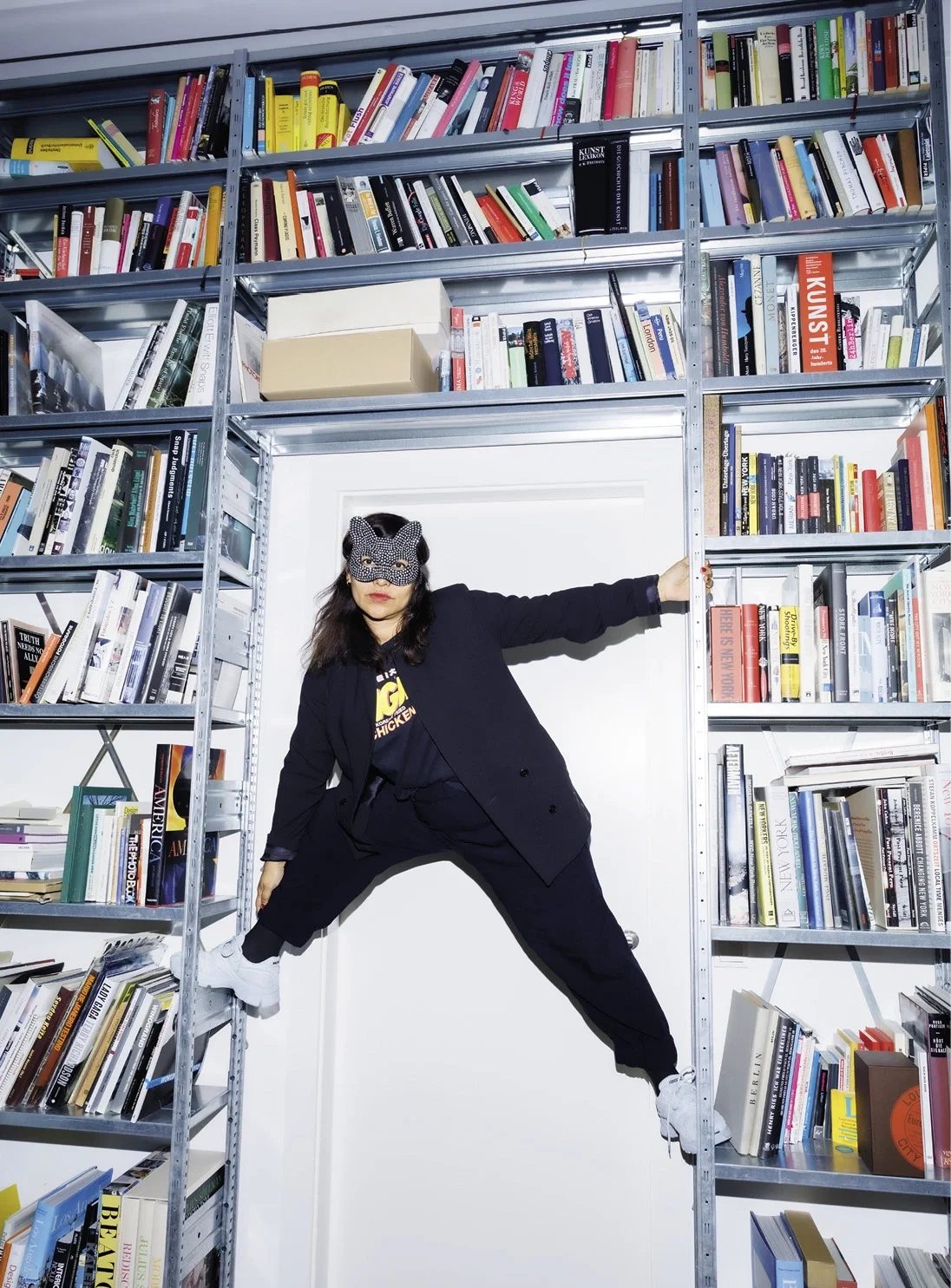
“I Didn’t Want to Follow Trends, I Wanted to Create Trends”
Kozva Rigaud is CEO and founder of the artist agency Shotview, which represents image-makers from various disciplines: from photography and film direction to styling, make-up and hair, as well as casting. With offices in Berlin, Paris, and Vienna, the agency offers independent creatives a valuable network.
Ms. Rigaud, how did you come up with the idea of founding Shotview?
I grew up in Lima, Peru, where, even as a teenager, I made contacts within the contemporary modern-dance scene; after finishing school, I completed a classical education at the Mozarteum in Salzburg and then went to New York. After my training, I asked myself the question, “Is that all?” I loved dancing, but I wanted more. Just as I began dancing for companies in New York, I very quickly realized how hard life as a dancer or choreographer is. In New York, it is extremely difficult for a creative to make a living without countless side jobs; most people have two or three jobs and can barely make ends meet. Therefore, I decided to further my education in the field of art management; my dream was to support creatives.
It simply did not make sense to me that artists earn less than everyone else. Why? What are we doing differently? What can we do better? Because I was interested in artist management, I enrolled in a marketing program and focused intensively on the question of how I could meaningfully combine creativity and management for myself. From then on, I became increasingly immersed in the idea that there are people who are not only creative, but who also want to bridge this gap between the creative and the business side at the same time. When I returned to Austria, I had gained considerable experience and was ready to make my ideas and dreams a reality. I had always been very strongly connected to photography and film, but also to art and communication – even then, my particular passion lay in the fashion industry. I worked very successfully for some time at Getty Images (one of the world’s largest image databases and producers of images, editor’s note), which enabled me to gain a well-founded insight into the processes of the photography business. Those were extremely exciting and educational years. Afterwards, at the beginning of the Internet age, I worked for some time in marketing and sales – this was a wonderful and valuable experience for me. It helped me gain self-confidence and realize my vision of becoming self-employed. I had always been involved with photography, art, and exhibitions, and so I eventually founded my agency. It was very clear to me that visual imagery would become increasingly relevant in the future, so we had to create space for creative people, and I wanted to actively shape this. I wanted to build a bridge between photographers and the editorial, advertising, and fashion worlds. I see myself as a mediator between artists and clients, both in the analogue as well as the digital visual world.
What are the particular challenges and joys associated with your work?
We represent creatives from various areas of photography, filmmakers, stylists, hair and make-up teams, and also casting agents. We build a relationship between creatives and clients. Here, it is important that every artist develops and expands their own visual language. We help the artists from the very beginning to find a visual language that is right and coherent for them. As in any relationship, in our working relationship we must all repeatedly question ourselves, challenge the relationship with one another, and define and further develop goals. Finding their own language as a creative is particularly important to me. For this reason, it is personally very important to me that every artist develops their very own personal visual working style. I try to avoid overlaps and enable myself to be a mentor, so that everyone can find their own path. The challenge is precisely that: defining your own path and doing so together. When this succeeds, the collaboration is a great joy. I have my artists’ backs, so that everyone can focus as much as possible on the creative realization.
Can one say that enabling this absolute freedom is your agency’s unique selling point?
For me, it is always very important that every team member has their own voice. This is how I understand cooperation in the working world – as absolute freedom in individual development. I myself did not want to follow trends, I wanted to create trends. It is absolutely essential to build the best possible network of creatives; in my opinion, this is the most important task and also a very challenging one. We have to grow together and question our collaboration from time to time in order to truly create something unique and new – and, on the other hand, to find the right commissions for each individual artist. This year, we were allowed to photograph Balenciaga’s worldwide campaign with our photographer Daniel Roche, which was of course a great pleasure for all of us, and the execution was a wonderful experience. When we then worked for clients such as Balenciaga, Louis Vuitton, Hermès, as well as for corporate clients such as Deutsche Bank, Lufthansa, or Siemens, we all became more aware of the importance of different voices and also learned to appreciate them. I want to emphasize the necessity of channeling the highest possible degree of creativity in the right way.
At this point, your agency’s work has a connection to anthroposophical values, correct?
Exactly. We identify with anthroposophical values, which are concerned with the further development of human beings and the spirit. We understand that we ourselves must change with exactly this drive.
What was decisive for Shotview’s success?
I have a fantastic team. The team members see that the beautiful thing about visual language and its vocabulary is that it is, or rather they are, universally understandable. As already mentioned: It is very important to continually add new voices to our Shotview choir – this is a process of constant growth and learning.
How can images achieve this goal compared to the written word?
From the very beginning, we understood ourselves as visual storytellers, because it was clear from the outset that the visual world, or visual language, would become increasingly important and would increasingly become the predominant form of communication. You can see this across all media, not only in classic media such as print magazines and films, but also in new forms of communication such as social media: TikTok, Instagram, Facebook. We therefore continually see a new language, new words, and new means of communication that these platforms have created.
What is art to you?
For me, art is something that emerges from the innermost part of a person – from no client. It is not commissioned work, but something that arises from an inner urge and presents and opens up a new cosmos to us as viewers. In order to keep the terminology clearly and cleanly separated: for bringing artists together with collectors or museums, there are gallery owners and art dealers as intermediaries; we at Shotview see ourselves as mediators of creatives in the field of applied art – meaning: our artists create highly creative works for clients. In productions for editorial work or magazines, both analogue and digital, the freedom for photographers is very great, and as an agency we strongly promote and demand this.
How have the creative visual media changed in recent years?
We have seen that digitalization in photography is a revolutionary development in many respects. Today, it is easy to see that all media have begun to move, through TikTok, Instagram, and Facebook. Analogue magazines no longer have the reach they had in previous years. We embrace this development with great enthusiasm – that means we are also part of this awakening and upheaval. Digitalization is a huge topic and, above all, a huge opportunity, and I think that creativity benefits greatly from this development. A strong democratization can be observed: everyone can develop content, and the financial barriers to entry are no longer as high as they were a few years ago. I see this as a huge opportunity and creative development. Producing visual content has become much easier on the one hand – on the other hand, the distribution of content has been completely turned upside down.
Kozva Rigaud is the founder and managing director of Shotview, an agency that supports creatives from a wide range of fields. She is a former dancer, completed a classical education at the Mozarteum in Salzburg, and then spent some time in New York before founding her agency.
Photos: Peter Rigaud